She Looked Like Just a Kid in Seat 12F. Then the Plane Fell 30,000 Feet and the F-22s Arrived. When the Pilots Heard Her Voice on the Radio, They Froze. This Isn’t a Story About a Bumpy Landing. This Is the Story of What Happens When a Sixth-Grader Has to Save 156 Lives.
Part 1
Alex “Thunder” Williams sat in seat 12F of United Airlines flight 1847, looking exactly like what everyone expected to see: a kid traveling alone. She had messy blonde hair tied in two braids, wore a faded purple T-shirt with a cartoon character on it, and carried a small pink backpack covered in sparkly stickers. Her legs, clad in light-up sneakers, barely reached the floor. She was deeply invested in a children’s book about dragons, her brow furrowed in concentration, while quietly sipping an apple juice box.
The flight attendant, Mrs. Rodriguez, had made a point to check on her every few minutes. She had a soft spot for unaccompanied minors; they always looked so small and brave.
“Are you doing okay, sweetie? Do you need anything? Another juice?”
“I’m fine, thank you, ma’am,” Alex replied politely, her high, sweet voice the exact one adults expected from children. “My grandma is picking me up in Chicago. She’s making cookies.”
“Well, isn’t that nice,” Mrs. Rodriguez smiled, patting her on the shoulder before moving down the aisle.
Other passengers smiled at the well-behaved little girl. A businessman in 12E, his laptop open to a complex spreadsheet, had offered her his extra bag of peanuts. An elderly woman in 12D, her face a kind map of wrinkles, asked if she wanted to see pictures of her own granddaughter. Everyone on that plane treated Alex exactly like what she appeared to be: an innocent, slightly nervous child on her first solo flight.
What none of them knew—what no one could possibly know—was that Alexandra “Thunder” Williams held one of the most classified positions in the United States military.
At 11 years old, she was the youngest person ever to complete pilot training. She had been “flying” experimental aircraft since she was nine. Her small size, coupled with a brain that processed spatial-temporal data faster than a quantum computer, made her the perfect and only candidate for testing a new generation of tiny, neural-linked unmanned combat vehicles that adult pilots couldn’t fit inside, let alone mentally handle.
Alex’s call sign, “Thunder,” had been earned. Not given. It was earned a year ago, when she’d successfully completed a test flight in the ‘Phoenix’ prototype—a mission that had killed three highly-decorated adult pilots before her. Her reflexes were faster, her fear responses were different, and her brain processed catastrophic failure as just another data set to be solved.
But Alex’s work was so secret, so deep-black, that even her own family didn’t know what she really did. To them, she was just a smart kid who went to a special, very expensive boarding school for “gifted children.” Only a handful of people in the entire military-industrial complex knew that America’s most advanced combat theories were being tested by a sixth-grader who still lost teeth and loved cartoon movies.
Captain Sarah Chin had been flying commercial airplanes for 12 years. She loved the sky. She loved the solid, dependable feel of the Boeing 737 beneath her. She had never experienced anything like what happened at 1:30 p.m. over Iowa.
United Flight 1847 was cruising peacefully at 38,000 feet, carrying 156 passengers from Denver to Chicago. The air was clear. It was a perfect, boring flight.
Then Captain Chin felt something that made her blood run cold. A vibration.
“Mike,” she said to her First Officer, Mike Torres, her voice calm, professional. “Are you feeling that vibration?”
Torres, who had been monitoring the fuel flow, immediately noticed it. This wasn’t turbulence. This was a deep, rhythmic, wrong vibration, like a washing machine full of bricks. And it was getting worse.
“That’s not good,” Torres said, his eyes flicking to the engine instruments. “Engine No. 2 is showing abnormal EGT readings. Spooling down…”
Before he could finish the sentence, a “BANG” that shook the entire aircraft rattled the fillings in their teeth. The cockpit lit up like a Christmas tree.
“Engine 2 failure!” Torres yelled.
“We’ve got major engine problems,” Captain Chin announced, her hands already moving, disabling the malfunctioning engine, fighting the yoke as the plane tried to yaw. “I’m declaring an emergency.”
“Chicago Center, United 1847, declaring an emergency,” she transmitted, her voice tight. “We have a severe engine failure. Requesting immediate assistance.”
“United 1847, Chicago Center copies your emergency. What are your intentions?”
“We need vectors to the nearest suitable airport. We may not be…”
She was cut off by a second, even more violent BANG. The other engine.
“Engine No. 1 is failing!” Torres shouted, his voice cracking with a new, raw panic. “We’re losing all power! All power!”
In seat 12F, Alex felt the changes long before the other passengers. She felt the micro-vibrations of the failing bearings in Engine 2. She felt the asymmetric thrust as Captain Chin fought to compensate. She heard the ka-thunk of the failed turbine shaft in Engine 1.
And she knew.
Her training, her entire life, had been based on one, unbreakable rule: Never reveal your identity. Never break cover. The program is more important than you. The program is more important than anyone.
Her orders were clear. She was to sit in her seat, like the little girl she was pretending to be, and let the adults handle it.
Even if it meant letting 156 people die.
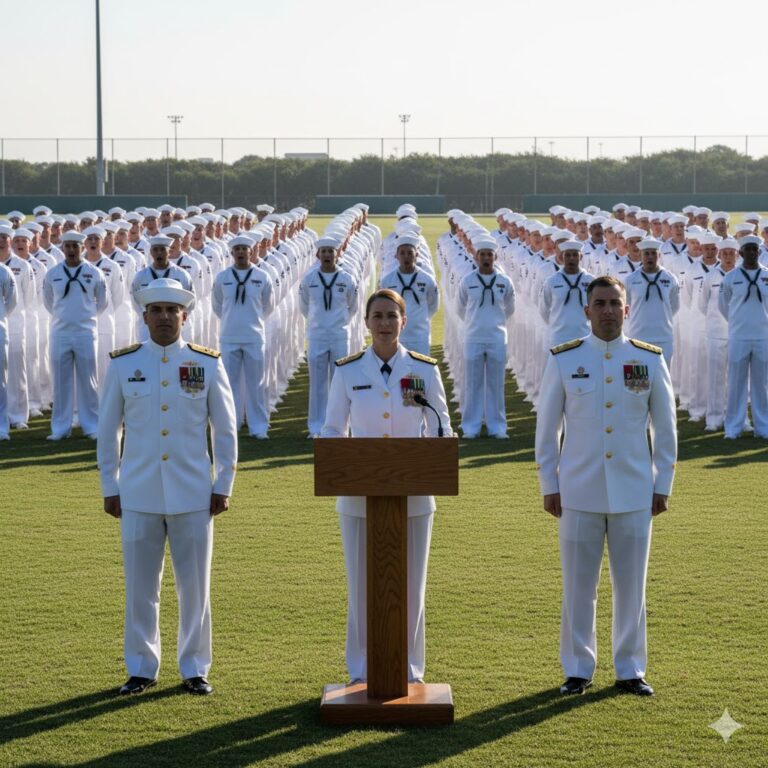
When United Flight 1847 declared an emergency over Iowa airspace, the North American Aerospace Defense Command (NORAD) immediately began tracking the situation. A commercial aircraft with dual engine failures was automatically flagged, especially one flying near sensitive military installations.
“Sir,” reported Major Lisa Rodriguez to Colonel James Parker at NORAD Command, “we have a commercial emergency, United 1847. They’ve lost both engines. They’re dropping. They may need to land at Offutt Air Force Base.”
“What’s the situation?” Colonel Parker asked, his eyes on the blinking red dot on the main screen.
“One hundred fifty-six souls on board. They’re at 30,000 feet and falling fast. They’re a glider now, sir.”
“Scramble F-22s immediately,” Colonel Parker ordered, his voice all business. “I want that aircraft escorted. I want eyes on it. If they need to land at Offutt, we need to be ready. Get me a manifest.”
Within minutes, two F-22 Raptor fighters from the 55th Wing at Offutt Air Force Base were climbing rapidly, their engines blasting them through the sound barrier. Major Kevin “Shark” Thompson and Captain Jennifer “Viper” Williams were two of the best pilots in the Air Force.
“Chicago Center, Raptor 1 and Raptor 2 are airborne and climbing to intercept United 1847,” Major Thompson transmitted, his voice calm.
“Raptor flight, United 1847 is at flight level 280, descending. Provide escort and assessment. Godspeed.”
As the F-22s approached their target, they prepared for what they expected to be a routine, if tragic, escort mission. But routine was about to become impossible.
As the Raptors took position, NORAD Command was reviewing the passenger manifest. Technical Sergeant Maria Santos was running the names, a standard, grim security procedure.
“Sir,” she said, her voice suddenly thin. “You need to see this passenger list.”
“What is it, Santos?” Parker grunted, his eyes on the altitude reading, which was now 25,000 feet.
“Passenger in seat 12F. Listed as Williams, Alex. Age 11.”
“An unaccompanied minor. Tragic. Go on.”
“Sir,” Santos said, her hand trembling. “When I ran that name through our classified cross-check… it flagged. Sir, it flagged hard.”
Parker turned. “What do you mean, it flagged?”
“It… it’s her, sir. Seat 12F. The call sign… it’s ‘Thunder.'”
The blood drained from Colonel Parker’s face. He grabbed his secure, red-line phone. He wasn’t calling Offutt. He was calling the Secretary of Defense.
“Sir, we have a Broken Arrow,” Parker said into the phone, using the code for a lost nuclear asset. “No, sir, not a nuke… It’s her. She’s on that plane.”
Part 2
The silence in the NORAD command center was absolute. The only sound was the quiet, terrifying beep of Flight 1847’s icon dropping altitude. 22,000 feet. 21,000 feet.
“Get me Raptor 1,” Colonel Parker commanded, his voice a strained rasp. “Secure channel. Now.”
Aboard Raptor 1, Major “Shark” Thompson was flying a perfect, respectful formation off the 737’s dying wing. He could see it clearly. The smoke. The dead, windmilling turbines.
“This is not good, Viper,” he said to his wingman. “He’s too heavy and he’s dropping too fast. He’s not going to make Offutt. He’s not going to make anywhere.”
“I copy, Shark,” Captain “Viper” Williams replied, her voice tight. “This is a bad day.”
Then, Shark’s comms crackled. A new voice, overriding the civilian frequency. It was NORAD.
“Raptor 1, this is Sentinel. You have a high-value asset onboard that aircraft. I repeat, you have a critical asset onboard.”
Shark frowned. “Sentinel, this is Raptor 1. Be advised, this is a civilian airliner. The asset is… 156 civilians.”
“Negative, Raptor 1!” Parker’s voice was frantic. “You have a single asset. We are classifying this mission: ‘Asset Recovery.’ The call sign is… Thunder.”
Shark’s hands, rock-steady on his stick, went numb. He and Viper, flying in perfect, silent unison, looked at each other across the empty sky.
“Thunder?” Viper’s voice came over their private channel. “Shark, did he say Thunder? That’s not a person. That’s a myth. That’s the Phoenix Program.”
“Sentinel, repeat that last,” Shark said, his own voice now shaky.
“The asset is Thunder,” Parker repeated, his voice breaking. “She is in seat 12F. Do not let that plane go down. That is your only objective.”
Shark looked at the massive, wallowing 737. It was a dying whale. And NORAD was telling him that the most valuable, most secret, most mythical asset in the entire US arsenal was trapped inside, sitting in economy class.
Inside the cabin, it was chaos.
The second engine failure had plunged the plane into a terrifying silence, broken only by the shriek of the wind and the rising panic of the passengers. The oxygen masks had dropped, a hundred yellow cups swaying in a macabre dance. People were screaming. They were praying. They were crying.
The plane gave a violent lurch, dropping a thousand feet in two seconds. The businessman in 12E was hyperventilating, his eyes wide with terror. The kindly old woman in 12D was clutching her rosary, her lips moving silently.
Mrs. Rodriguez, the flight attendant, was a hero. She was unbuckled, moving down the aisle, trying to force people to stay calm. “Brace for landing! Brace for landing!” she shouted, her voice straining.
Alex sat in 12F, her small hands gripping the armrests, her knuckles white.
I am not allowed. My orders are clear.
The plane dropped again, a gut-wrenching fall. The overhead bins popped open, raining luggage and carry-ons into the aisle. Mrs. Rodriguez was thrown against a bulkhead, and she went down, clutching her arm.
They are all going to die. 156 souls. And me.
Alex’s brain, her unique, terrifying brain, was not in a panic. It was calculating.
Altitude: 18,000 feet. Airspeed: 290 knots. Rate of descent: 4,000 feet per minute. Both engines dead. APU is fried from the second engine’s uncontained failure. Hydraulics: failing. They have 4 minutes. 30 seconds.
She looked at Mrs. Rodriguez, crying in the aisle. She looked at the businessman, writing a note on a cocktail napkin.
The mission is void if the asset is dead. I am the asset. My new mission is survival.
It was the loophole she needed.
She unbuckled her seatbelt. The light-up sneakers hit the floor.
She stood up.
The businessman in 12E, his face slick with tears, grabbed her arm. “Sit down, kid! You have to sit down!”
Alex turned to him. Her blue eyes, normally wide and innocent, were now the color of a winter sky. They were cold.
“Let go of my arm, sir,” she said. Her voice was no longer high and sweet. It was a low, clear, command-tone.
He let go, stunned.
She stepped over the debris in the aisle and walked toward Mrs. Rodriguez, who was trying to get up.
“Ma’am, are you okay?” Alex asked.
“Sweetie, no! Get back in your seat! Please!” Mrs. Rodriguez sobbed, a mix of pain and fear.
“Ma’am, I need your key,” Alex said.
“What? My key? Honey, we are…”
“Your cockpit key. I need it. Now.”
Mrs. Rodriguez stared at her. “What are you talking about?”
“The pilots,” Alex said, her voice sharp, “are in a full stall. They’re trying to fly a 400,000-pound glider, and they’re fighting the yoke, which is killing their airspeed. They’ve lost primary hydraulics, and they don’t know that the manual trim is still active. We have 3 minutes until we’re on the ground, and not at an airport. Give me the key.”
The flight attendant’s face went from fear to utter, blank confusion. “How… how do you…”
“NOW!” Alex screamed, her voice echoing the call sign she’d earned. It was the sound of thunder.
She didn’t wait. She ripped the key, hanging from a lanyard on the attendant’s neck, and ran.
She ran toward the cockpit, dodging panicked passengers, vaulting over suitcases. She got to the reinforced cockpit door. She didn’t knock. She used the key, entered the emergency code, and slammed the door open.
Inside the cockpit, Captain Chin and First Officer Torres were fighting for their lives. The yoke was heavy, unresponsive. The alarms were a single, deafening shriek.
“We’re too low, Sarah!” Torres yelled. “We’re not gonna make it!”
“Work with me, Mike! Work with me!” Chin grunted, pulling on the yoke with all her strength.
The door burst open.
They both turned, expecting a hysterical flight attendant.
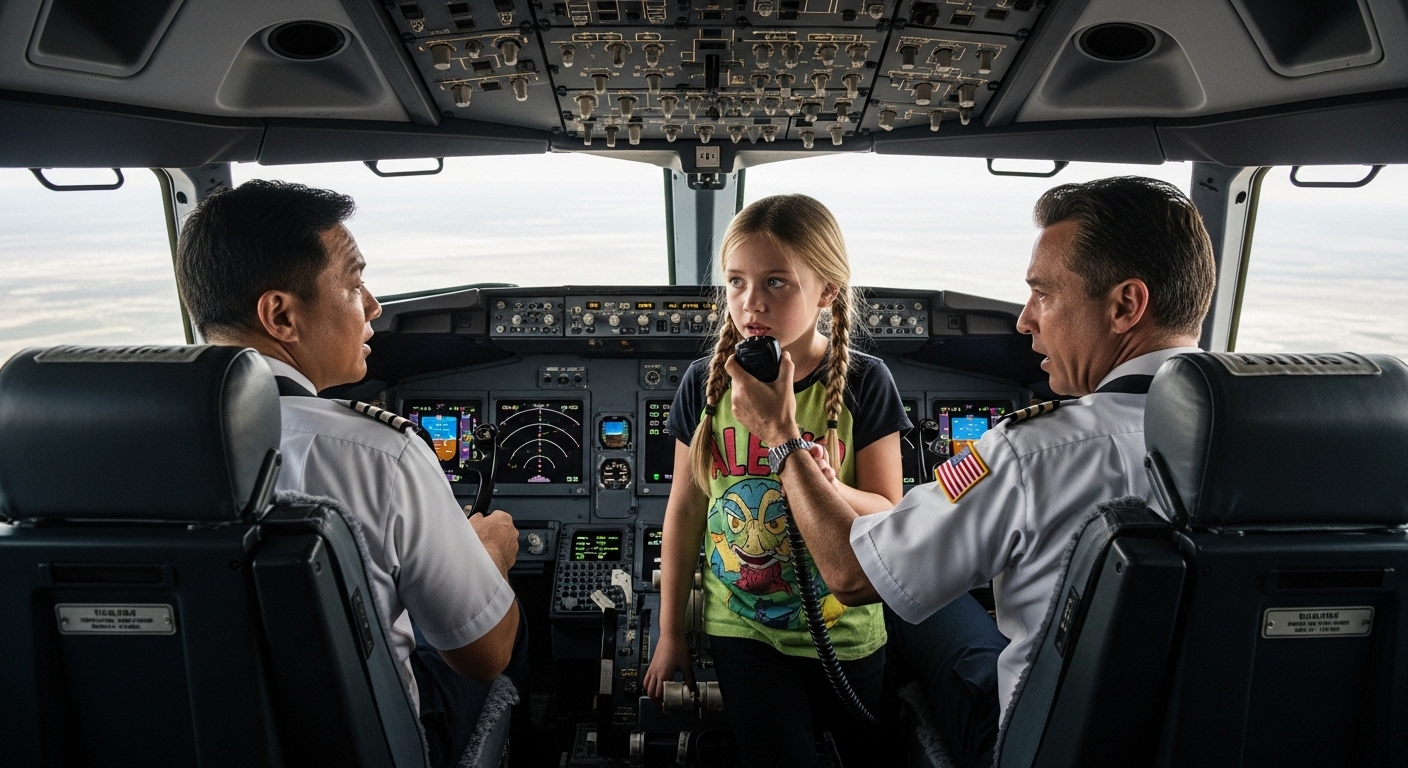
They saw an 11-year-old girl with blonde braids and a cartoon T-shirt.
“GET OUT OF HERE, KID!” Torres screamed, his mind snapping. He thought it was a hallucination.
“You’re in a stall,” Alex said, her voice cutting through the alarms. “You’re pulling back. You need to push forward. You need to trade altitude for airspeed.”
“Get her out of here!” Captain Chin yelled, not looking. “Get her…”
“You’ve lost hydraulics, but your manual trim is still live!” Alex shouted. “You’re fighting a plane that’s trying to save itself! Give me the radio!”
She didn’t wait. She jumped into the small space between them, grabbed the co-pilot’s headset, and jammed it on her head. She hit the transmit button.
Her voice, clear and pure, cut through the emergency frequency.
“Raptor 1, Raptor 2, this is United 1847. I have a passenger in the cockpit!” Captain Chin yelled into her own mic, trying to report the breach.
Alex overrode her. “Raptor 1, Raptor 2, this is Thunder. I repeat, this is Thunder. Authentication: Sierra-Echo-Romeo-Echo-November-Seven. I am declaring a ‘Broken Arrow’ scenario. The asset is compromised. I am taking command of this aircraft’s descent. How copy?”
In the F-22, Shark and Viper heard it. First, the pilot’s panic. Then… the voice.
It wasn’t a kid. It wasn’t an adult. It was… something else.
“…this is Thunder. Authentication: Sierra-Echo-Romeo-Echo-November-Seven.”
It was her authentication code. The real one.
Shark’s blood turned to ice. He keyed his mic, his voice pure steel.
“Thunder, this is Raptor 1. We copy. We have you. Authentication is valid.” He took a breath. “United 1847, this is Raptor 1. The… passenger… in your cockpit is now in command. I repeat, she is in command. Stand down and follow her instructions. That is a direct order from NORAD.”
In the cockpit, Captain Chin and First Officer Torres froze. They had just heard a high-performance F-22 pilot take orders from an 11-year-old girl.
“Who… who are you?” Chin whispered, her hands falling from the yoke.
“I’m the person who’s going to save this plane,” Alex said. She climbed into the co-pilot’s seat, pushing a stunned Torres’s hands away. “Now, fly-by-wire is dead. You’re flying on cables. This isn’t a 737 anymore. This is a 400,000-pound Cessna. You have to feel it. Now, push the nose down. We need speed.”
“We’ll lose too much altitude!” Torres protested.
“We have altitude to spare! We have no speed! We’re a falling brick!” Alex yelled. “DO IT!”
Captain Chin, her face pale, made a choice. She trusted the voice in her headset. She pushed the yoke forward.
The plane responded. The horrible stall-shudder stopped. The shrieking of the wind changed from a howl to a roar. They were flying. Barely.
“Okay,” Alex said, her hands flying over the manual trim wheels, spinning them with a speed that was inhuman. “We’re in a glide. Raptor 1, I need a visual on my port wing. Are the flaps responding to manual input?”
“Negative, Thunder,” Shark’s voice came back. “Flaps are gone. You’re leaking fuel, and it looks like the landing gear is… it’s not deploying, Thunder.”
Alex didn’t hesitate. “Copy. We’re going in heavy and hot. Offutt is too far. What’s my nearest strip?”
“Sioux Gateway. 30 miles. You’re too low, Thunder. You’re not gonna make the glide.”
Alex looked at the panel. “Yes, I will. Captain Chin, I need you to trust me. We’re going to land this plane.”
For the next ten minutes, a small, 11-year-old girl in a cartoon T-shirt, flanked by the two most advanced fighter jets on Earth, gave commands to two veteran pilots. She “felt” the air. She used the wind. She coaxed the dying plane, playing the trim against the rudders, fighting for every single foot of altitude.
“Raptor 1, I’m lined up for Sioux Gateway,” she said, her voice now showing the strain. “Clear the field. I have no brakes, no landing gear, and no reverse thrust. This is a belly landing. It’s going to be hot.”
“It’s clear, Thunder,” Shark’s voice came back, thick with an emotion he couldn’t name. “The field is yours. Godspeed.”
“Captain Chin. First Officer Torres,” Alex said. “This is it. When we hit the ground, it’s going to be violent. Keep her steady. No matter what, keep her wings level.”
They hit the runway at 190 knots. Not with wheels, but with the fuselage.
The sound was the most horrible sound any of them had ever heard: the shriek of a million fingernails on a blackboard, the sound of a giant being torn in half. Sparks. Fire. The plane skidded, turning sideways, a massive, out-of-control metal beast. It tore through the grass, the mud, the runway lights.
It finally, finally, slid to a halt, tilted on its side, in a field of Iowa corn.
For a second, there was silence.
Then, the emergency doors blew. The flight attendants, including a one-armed Mrs. Rodriguez, were screaming. “Unbuckle! Get out! Leave everything! Run!”
Alex unbuckled. She was shaking. The adrenaline was gone. She was just a kid again.
Captain Chin, her face streaked with sweat, grabbed her arm. Her hand was trembling. “Who… what are you?”
Alex looked at her, and her eyes, the cold, calculating eyes of “Thunder,” were gone. They were replaced by the terrified, wide eyes of an 11-year-old. Tears streamed down her face.
“I’m just a kid,” Alex whispered. “Please. I’m just a kid.”
She got up and joined the flood of screaming passengers, vanishing into the crowd, her pink backpack still on her shoulders.
On the tarmac, as fire trucks raced to the smoking wreck, the 156 passengers and crew were being herded. Alex was sitting on the back of an ambulance, wrapped in a blanket, sipping an apple juice someone had given her.
The two F-22s did a low, slow pass over the field. They didn’t waggle their wings. They just saluted. Then they vanished, climbing straight up into the sky.
A black, unmarked SUV, ignoring all airport protocol, drove across the grass and screeched to a halt in front of Alex.
Colonel Parker got out. He walked past the pilots, past the shell-shocked FBI agents, straight to Alex.
He knelt in the mud. His uniform was perfect.
“Good job, Thunder,” he said, his voice quiet.
“I broke protocol, sir,” Alex whispered, her voice tiny. “I’m sorry.”
“You saved 156 lives, including your own. Protocol’s a little flexible on that. Your grandmother’s on her way. She’s been told you had a… ‘bumpy landing.'”
He looked over at Captain Chin and First Officer Torres, who were staring at the scene, dumbfounded.
“As for you two,” Parker said, walking over, his voice now hard as iron. “You flew that plane. You are heroes. You have no idea how you did it, a ‘miracle’ you’ll call it, but you did it. You never saw a little girl in your cockpit. The alternative involves a long, long conversation in a windowless room in Virginia. Are we clear?”
They both nodded, speechless.
Parker walked back to Alex. He gently wiped a smudge of dirt off her cheek. “You’re going to be okay, kid. You’re going to be okay.”
Alex just nodded, clutching her blanket. She looked at her dragon book, now muddy and torn, lying in the grass. She was just a kid. But she was also Thunder. And she was very, very tired.